
Stamped · Colored · Sealed
Decorative concrete
Pool decks and coping, patios, front walks, entry plazas and driveways in stamped, colored, exposed aggregate and textured finishes — placed by the same crews that pour our structural work, on a slab built to outlast the pattern on top of it.
What it actually is
Decorative concrete is flatwork first
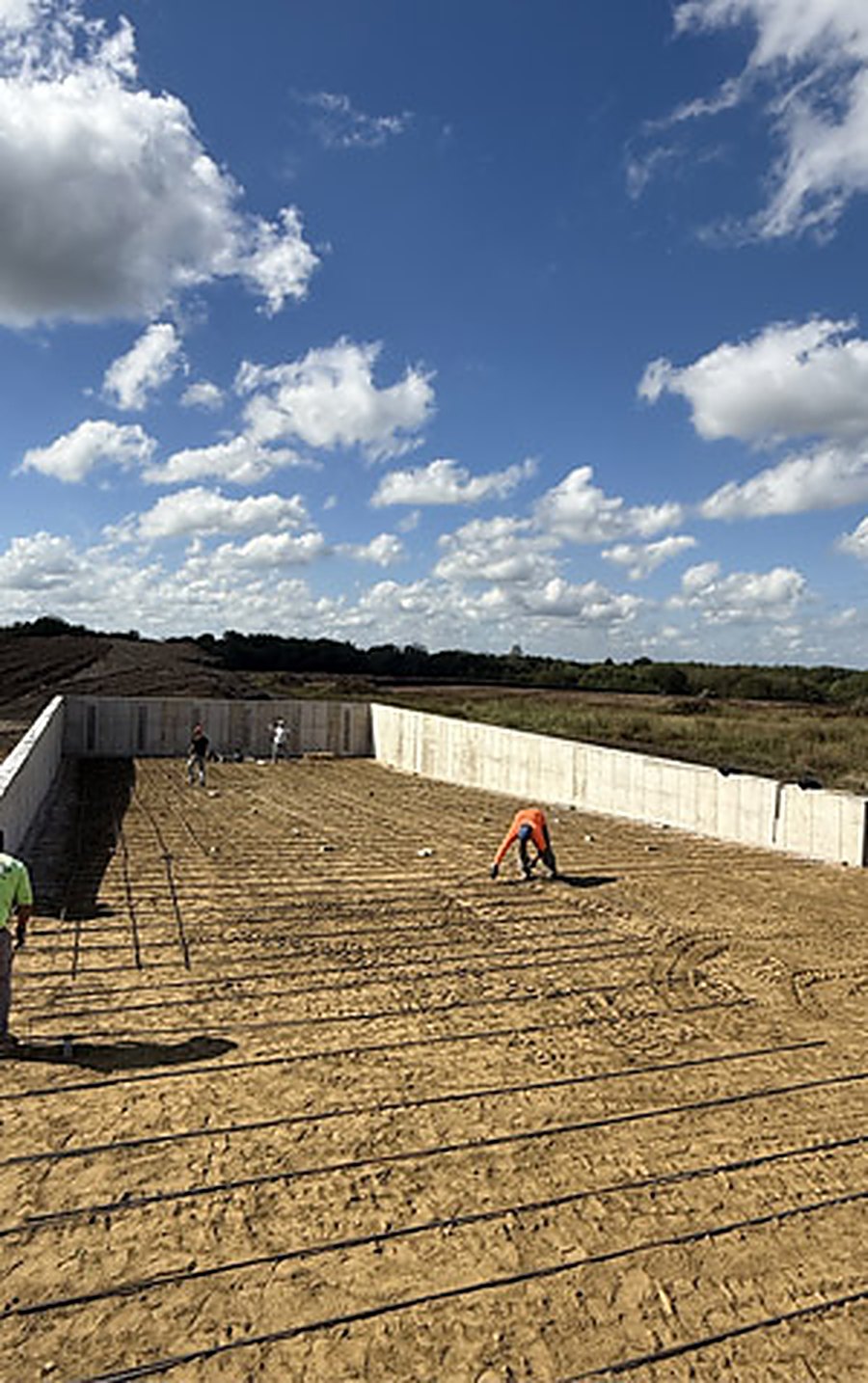
Color and texture are the last two hours of the job. Everything that decides whether a deck still looks right in ten years happens before the first truck shows up — subgrade, thickness, reinforcement, drainage and where the joints land. We build the slab the way we build our slabs and flatwork, then decorate it.
- Subgrade compacted and base stone even, so the slab isn’t bridging soft spots
- Thickness and reinforcement — fiber, WWF or rebar — sized to what parks or sits on it
- Isolation joints where the slab meets the house, the pool shell, columns and footings
- Forms set to a drainage slope, so water leaves the surface instead of pooling in a corner
- Air-entrained mix and a controlled slump wherever it freezes, decorative or not
- Joint layout drawn and approved before the pour, then cut on that layout
No truck access to the back yard is normal on this kind of work. A line pump or boom gets the concrete where the wheelbarrows can’t — see concrete pumping and placement.
Finishes and color
Six ways to change what a slab looks like
Most jobs use two or three of these together — a stamped field with a broomed border, integral color with a hardener over it. The reason to decide early is that half of these choices are made at the batch plant, not on the slab.
Stamped patterns and textures
Mats pressed into the slab while it is still in the window: stone, slate, plank, brick running bond. Powdered release keeps the mats from sticking and leaves a second accent color in the texture; clear liquid release does not. Edges, radiuses and tight corners get worked with texture skins so the pattern runs all the way to the form.
Integral color
Pigment dosed into the load at the plant, so color runs through the full thickness. A chip or a saw cut shows colored concrete, not gray. Order the whole placement out of one batch run where you can — separate loads and separate days can read differently, and there is no fixing that after the fact.
Color hardener
A dry shake broadcast onto fresh concrete and floated in. It gives a denser, more abrasion-resistant surface and deeper color than pigment alone, but only in the top layer — a deep chip still shows gray. Heat and wind make it a harder finish to place, and it is not the right call on every exterior mix. We will tell you which one your slab wants.
Stains and dyes
The option for concrete that already exists. Reactive acid stains work on the free lime in the slab and give a mottled, variegated look in a narrow earth-tone range; water-based stains and dyes cover far more color and read more uniform. Both depend on what is on the slab now — old sealer, curing compound, patches, efflorescence — so we test an out-of-the-way corner before we commit.
Exposed aggregate, broom and salt
A surface retarder washed off the next day exposes the stone in the mix. A broom finish is honest traction for very little money and drains well. A salt finish leaves a pitted texture — and where it freezes we will talk you out of it, because those pits hold water and spall the surface.
Saw cuts, borders and bands
The joints have to be there, so they may as well be part of the drawing: a cut grid turned on a diagonal, a contrasting soldier border, a broomed band framing a stamped field. Cuts go roughly a quarter of the slab depth and land on panels close to square — the pattern follows the joints, not the other way around.
Pool decks and coping
Around water, the finish is a safety decision
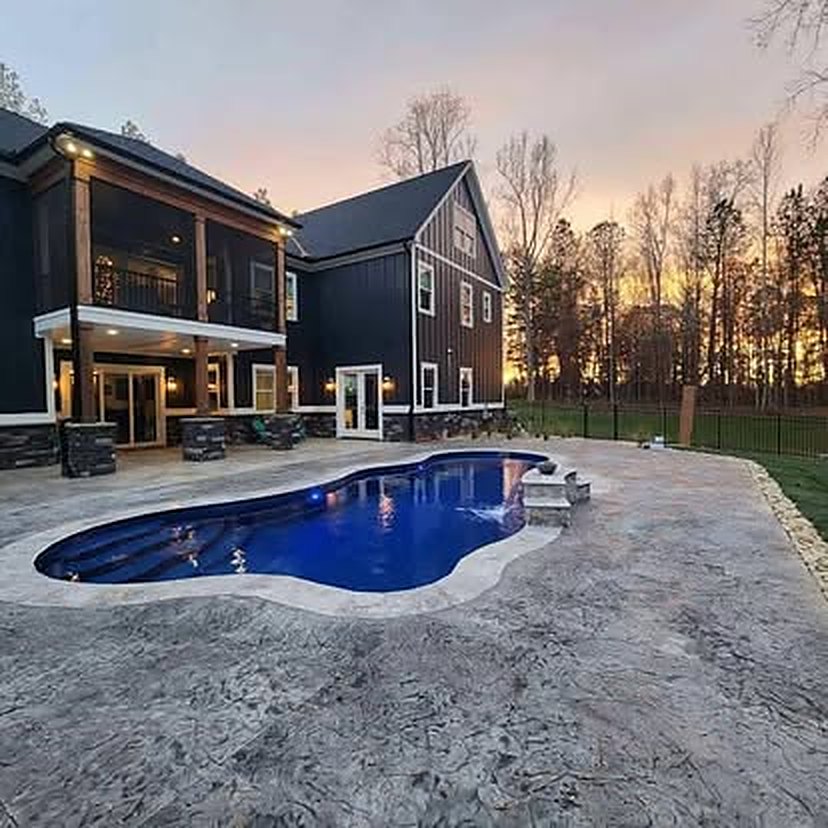
A wet deck with bare feet on it is the hardest surface on a residential job to get right. Texture, sealer and color all change how it behaves, and the glossiest option in the sample book is usually the wrong one.
- Texture that still grips wet — light stamp, broom or exposed aggregate, never a slick steel-trowel finish
- Fine grit blended into the top coat of sealer wherever people walk barefoot or on a slope
- Cantilever or bullnose coping formed at the shell, with an expansion joint between deck and pool
- Deck sloped away from the water so rinse and rain reach the deck drains, not the pool
- Color picked with the sun in mind — dark integral colors get genuinely hot underfoot
- Sealer chosen for pool chemistry, which is harder on a film than weather is
Grit in the sealer costs you a little sheen and a slightly coarser feel underfoot. That trade is yours to make, and we would rather you make it in front of a sample panel than the first hot afternoon after we leave.
How a decorative pour runs
Sample first, seal last
Two of these four steps happen before anyone touches concrete, and the last one happens days after the crew has gone home.
Sample and layout
Pattern, color, release and border picked off a sample we pour for you, not a paint chip. Joint layout gets drawn at the same time, because the cuts are part of the pattern.
Base, forms and steel
Subgrade compacted, base stone spread, forms set to the drainage slope, reinforcement tied, and isolation joints placed at the house, the pool shell and any footing.
Place, color and stamp
Mix ordered to a consistent slump and air content so the whole placement behaves the same. Screed, bull float, edge; color placed; release down; mats run in sequence while the slab is in the window.
Cut, wash, cure and seal
Joints saw-cut on the approved layout, excess release washed off once the surface will take it, and the slab cured and protected. Sealer is a separate trip onto a dry slab, not a pour-day afternoon.
The honest part
Sealer is maintenance, not a one‑time upgrade
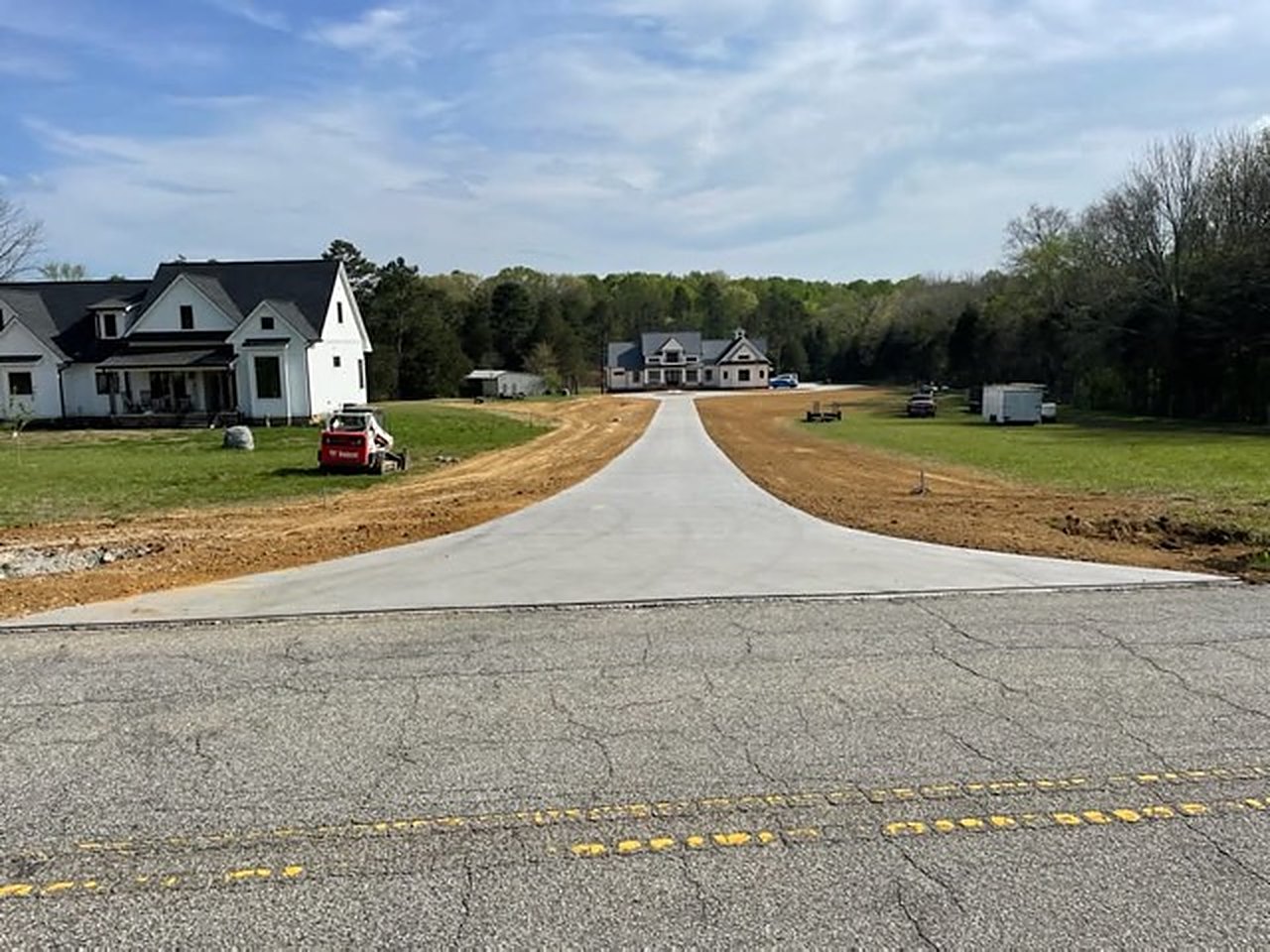
The film that makes stamped concrete look wet and makes the color pop is the same film that sun, traffic, snow shovels and pool chemicals wear off. Sealed decorative concrete gets resealed on a cycle. Anyone who tells you otherwise is quoting the first job and not the second.
- Film-forming acrylic: the wet look and the strongest color, and the shortest interval between recoats
- Penetrating sealer: longer service life, no sheen, much less color lift — often the better trade on a driveway
- Recoat before the surface goes chalky; piling coats onto a failing film only locks the problem in
- Whitening or blushing means moisture trapped under the film — that gets stripped and redone, not covered
- Keep deicing salts and lawn fertilizer off it, and rinse pool chemicals rather than letting them dry on the surface
How often depends on the product and how hard that surface lives. We will tell you the interval for the sealer we put on your slab, in writing, before we put it on.
Common questions
Before you sign off on a color
How often does decorative concrete need to be resealed?
It depends on which sealer is on it and what that slab lives through. A shaded patio goes much longer than a south-facing driveway that gets shoveled every winter, and a film-forming acrylic needs attention sooner than a penetrating sealer.
The slab tells you when: water stops beading, the color starts to look dry or chalky, the sheen goes patchy in the traffic paths. Recoating at that stage is a wash-and-roll job. Waiting until the film fails outright turns it into stripping, which costs several times more.
We put the interval for your sealer in the quote, and we will tell you honestly if a finish you like is one that needs more upkeep than you want to sign up for.
Will the pool deck be slippery when it’s wet?
Every hard surface is slicker wet than dry — concrete, tile, pavers, all of them. How much is a choice you make, not a property of the material.
Around water we keep real texture in the surface (light stamp, broom or exposed aggregate rather than a hard trowel), blend a fine grit additive into the top coat of sealer, and stay away from high-gloss products entirely. Sloping the deck so water actually leaves it does as much for traction as anything in a bucket.
What we will not do is promise a number. Slip resistance depends on footwear, wear, whatever is on the surface that day and how the deck is maintained — so we build in as much of it as the finish allows and tell you what each option costs you in feel and sheen.
Can you match my existing patio or driveway?
Close, usually. Identical, no — and anyone promising identical has not looked at the old slab. Cement and aggregate come from whatever source the plant is running now, the existing concrete has years of weathering and traffic on it, and if it was colored, that product may not be sold anymore.
Three honest ways to handle it: pour a sample and adjust the color until it sits comfortably next to the old work; make the transition deliberate with a border, a joint or a change in texture so the two slabs read as a design rather than a bad match; or stain and reseal both so they age together from here.
Worth knowing either way — new concrete keeps lightening for months as it cures. A sample that matches perfectly on day three will be slightly lighter by the time the furniture is back out.
Will stamped concrete crack?
Concrete shrinks as it dries, and ground moves. The job is not to prevent cracking, it is to decide where it happens: control joints cut on a planned layout, isolation joints at anything fixed, and reinforcement sized to hold what does crack tight and level.
Colored and stamped surfaces show a hairline crack more than a gray broom finish does, which is one reason pattern choice matters. A pattern with strong grout lines absorbs a stray crack; a large-format ashlar with wide, clean fields does not hide much. We will point that out while you are still choosing.
Start your project
Send us the plans. We’ll send back a number you can build to.
Takeoffs, budget pricing, and scheduling for commercial, industrial and residential concrete. Tell us the scope and the date you need to be out of the ground — we’ll tell you honestly whether we’re the right crew for it.